
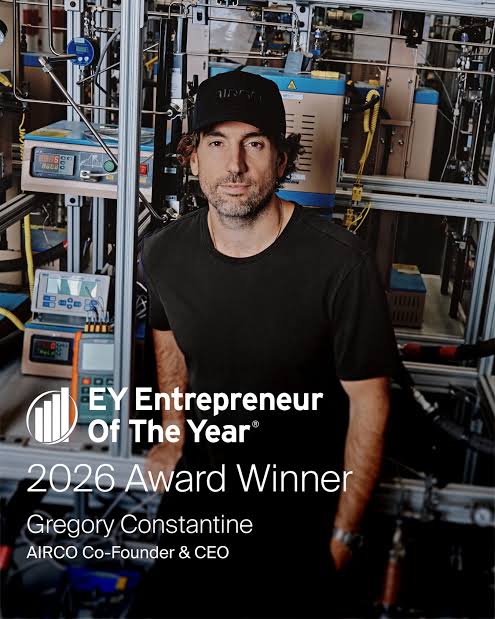
Innovation often begins with an ambitious vision, but turning that vision into a successful business requires more than breakthrough technology. It demands strategic thinking, patience, and the ability to adapt. Airco, a clean technology company founded in 2017, offers a compelling example of how entrepreneurs can transform an unconventional idea into a commercially viable enterprise by taking an unexpected path.
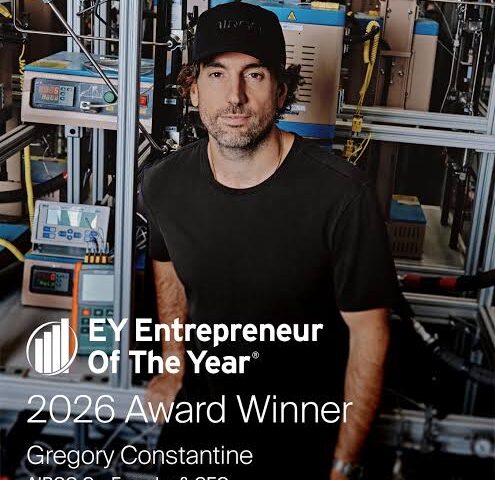
At the heart of Airco’s story is co-founder Gregory Constantine, a Harvard MBA graduate, who partnered with Dr. Stafford Sheehan, a Yale-trained chemist whose doctoral research focused on converting carbon dioxide into useful products. Together, they shared a bold objective: develop technology capable of capturing carbon dioxide directly from the atmosphere and converting it into sustainable aviation fuel.
However, the founders quickly recognized a significant challenge. Developing commercial aviation fuel from atmospheric carbon would require years of research, regulatory approvals, and substantial capital. Rather than spending years seeking investors for an unproven concept, they asked a more practical question:
What can we build and sell today that demonstrates our technology while generating revenue for tomorrow’s mission?
That question became the foundation of Airco’s business strategy.
Turning Carbon into Consumer Products
Dr. Sheehan successfully developed a process that converts captured carbon dioxide into ethanol. Instead of immediately targeting industrial fuel markets, the founders identified a consumer application that met three important criteria:
- It would attract public attention.
- It could command premium pricing.
- It would showcase the company’s groundbreaking technology.
The answer was Air Vodka—the world’s first vodka produced using water and carbon dioxide extracted from the air.
The product quickly attracted media attention for its environmental innovation and premium positioning. Rather than serving as Airco’s ultimate business objective, the vodka functioned as a powerful demonstration of the company’s technology and commercial capabilities.
Building on this success, Airco expanded into additional consumer products made using the same carbon-conversion process, including:
- A luxury perfume.
- Hand sanitizer during the COVID-19 pandemic.
These products generated revenue, increased public awareness, validated the technology, and helped establish credibility with customers and investors alike.
As Gregory Constantine later explained, these products were never intended to be the company’s final destination. They were designed as proof points that would finance and accelerate Airco’s larger mission.
Funding the Bigger Vision
The strategy proved highly effective.
Within three years, Airco had demonstrated sufficient technological and commercial success to attract institutional investors. The company secured seed funding before eventually raising more than $100 million to expand its clean-energy operations.
With stronger financial backing, Airco shifted its primary focus toward producing sustainable aviation fuel manufactured from captured carbon dioxide.
The company’s progress has been remarkable:
- Its synthetic aviation fuel has successfully powered a military test flight.
- Airco secured multiple government contracts.
- The company won a $65 million contract from the U.S. Department of Defense.
- Several commercial airlines have also expressed commitments to purchase the fuel once large-scale production becomes commercially available.
Airco has evolved from a startup selling premium consumer products into a significant player in the emerging sustainable aviation fuel industry.
Strategic Flexibility Over Rigid Planning
One of the most valuable lessons from Airco’s journey is the importance of strategic flexibility.
Rather than stubbornly pursuing their original commercialization plan, the founders adjusted their approach to match market realities. They recognized that achieving their long-term objective required first building credibility, generating revenue, and proving that their underlying technology worked.
Reflecting on the company’s evolution, Gregory Constantine observed that entrepreneurs often become overly committed to a single path. Success, he argued, frequently requires reassessing that path and choosing a route that better supports the ultimate destination.
Although Constantine and Sheehan have since separated and filed legal actions against one another, the business model they developed remains a noteworthy example of entrepreneurial execution.
A Similar Lesson from Lonnie Johnson
Airco’s strategy mirrors the entrepreneurial journey of Lonnie Johnson, an inventor, engineer, and former NASA scientist.
Johnson’s true passion lay in developing environmentally sustainable energy technologies. While experimenting with a water-powered heat pump in his spare time, he accidentally discovered an entirely different opportunity. A powerful stream of water inspired the idea for a high-performance water gun.
Rather than dismissing the concept as unrelated to his larger ambitions, Johnson licensed the invention to a toy company.
The result was the Super Soaker, one of the most successful toys in history, generating over $1 billion in sales.
The financial success of the Super Soaker enabled Johnson to establish his own research laboratory, attract investors, and continue developing advanced energy technologies, including:
- High-capacity batteries capable of powering electric vehicles for up to 800 miles on a single charge.
- Improved environmentally friendly heat pump systems.
Johnson has repeatedly stated that without the commercial success of his toy invention, he would not have had the financial freedom to pursue his long-term environmental innovations.
The Entrepreneurial Principle
Airco and Lonnie Johnson demonstrate a common entrepreneurial principle:
A company’s first successful product does not have to be its ultimate mission.
Instead, an initial product can serve as a strategic stepping stone by:
- Demonstrating technological capability.
- Generating sustainable revenue.
- Building brand recognition.
- Earning customer trust.
- Attracting investors.
- Financing future innovation.
Many of the world’s most successful companies have followed this approach. Tesla began with premium sports cars before expanding into mass-market electric vehicles. Amazon started as an online bookstore before becoming a global marketplace. Google used advertising revenue to fund ambitious ventures such as autonomous driving.
Airco follows the same pattern. What began as vodka made from captured carbon dioxide ultimately became the foundation for a business developing cleaner aviation fuel for military and commercial aviation.