
Growing a consumer brand into a billion-dollar business often conjures images of constant product launches, aggressive expansion, and endless experimentation. For Liquid I.V., however, the path to success looked remarkably different.
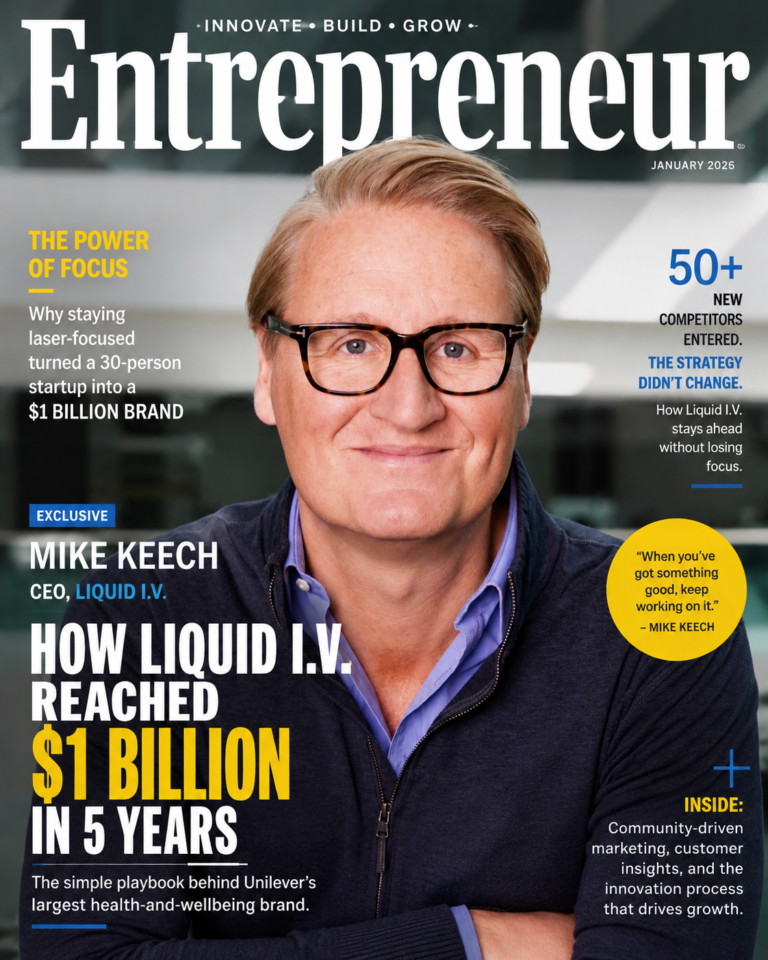
Under the leadership of CEO Mike Keech, the hydration brand grew from a 30-person startup generating approximately $100 million in revenue into Unilever’s largest health-and-wellbeing brand, surpassing $1 billion in retail sales within just five years.
Rather than pursuing every emerging trend, Keech credits the company’s rapid rise to one simple principle: focus.
“When you’ve got something good, keep working on it,” Keech says, emphasizing that businesses often lose momentum by chasing every new opportunity instead of strengthening what already works.
Building a Brand Around One Core Mission
Liquid I.V. specializes in powdered hydration mixes designed to improve hydration when mixed with water. Instead of rapidly diversifying into multiple product categories, the company concentrated on perfecting its flagship products while making them available to more consumers.
Keech believes many large consumer brands dilute their strengths by constantly pursuing “new shiny toys.” Liquid I.V. chose the opposite approach—investing heavily in improving its existing products, expanding distribution, and increasing consumer awareness.
According to Keech, the company’s growth strategy has always been centered on one question:
What are we truly great at?
By consistently answering that question and resisting unnecessary distractions, the company created a scalable business model capable of sustained growth.
Winning Consumer Trust Through Community Marketing
Launching a hydration product in an already crowded marketplace required more than traditional advertising.
Instead of relying on expensive celebrity endorsements, Liquid I.V. built its early marketing strategy around community-driven advocacy.
The company assembled a large network of micro-influencers—ordinary consumers with highly engaged audiences who genuinely used and believed in the product.
These creators became authentic brand ambassadors, helping introduce Liquid I.V. to consumers through relatable experiences rather than polished advertisements.
This grassroots strategy enabled the company to:
- Build credibility among first-time buyers.
- Generate authentic word-of-mouth marketing.
- Acquire customers more cost-effectively than traditional campaigns.
- Create long-term brand loyalty through genuine community engagement.
Keech describes this community-first approach as one of the company’s most successful early growth strategies.
Market Segmentation: Reaching the Right Consumer at the Right Time
One of Liquid I.V.’s earliest insights came from research suggesting that roughly 75% of Americans are chronically dehydrated, often without realizing it.
Instead of marketing hydration as a universal benefit, the company segmented consumers based on specific situations where hydration needs become particularly important.
The brand identified four primary use cases:
1. Nightlife Recovery
Consumers looking to rehydrate after late nights or social occasions.
2. Exercise and Fitness
Athletes and active individuals replacing fluids lost through sweat.
3. Travel Hydration
Travelers experiencing dehydration during long flights and extended journeys.
4. Heat-Related Hydration
Individuals exposed to hot climates or outdoor work requiring additional hydration.
This segmentation allowed Liquid I.V. to create highly targeted messaging that resonated with different customer groups while maximizing marketing efficiency.
Customer Research Drives Every Product Decision
Keech believes successful innovation begins with understanding problems—not creating products first and searching for customers later.
Liquid I.V. relies on three complementary research methods.
Continuous Market Research
The company purchases ongoing industry tracking data to monitor consumer behavior, market trends, and emerging opportunities while conducting deeper research before entering new product categories.
Social Media Superusers
Liquid I.V. maintains close relationships with its most passionate customers.
These “superusers” regularly provide feedback, test ideas, and participate in conversations that help shape future marketing and product development.
Rather than treating them simply as customers, the company considers them an extension of its internal team.
Direct Consumer Interaction
Keech places enormous value on spending time with customers face-to-face.
While reports, charts, and analytics provide useful insights, he argues that the most meaningful discoveries come from listening directly to consumers and observing how they use products in everyday life.
According to Keech, these conversations often produce the “aha moments” that cannot be captured through quantitative research alone.
Solving Consumer Problems Before Launching Products
Liquid I.V.’s expansion into the sugar-free energy category illustrates its customer-first innovation process.
Rather than creating another conventional energy drink, the company first studied consumer frustrations with existing products.
The most common complaint was consistent:
Many consumers disliked the jitters, sudden energy spikes, and crashes associated with traditional energy drinks.
Instead of introducing a similar product, Liquid I.V. developed a formula designed to deliver:
- Sustained energy
- Gentler stimulation
- Reduced crashes
- A smoother overall experience
Keech describes this philosophy as “zigging where others zag.”
Rather than copying competitors, the company identifies unmet customer needs and builds differentiated solutions around them.
Growth Through Depth Instead of Diversification
Many consumer packaged goods companies eventually diversify into entirely new product formats such as ready-to-drink beverages, gels, or liquid concentrates.
Liquid I.V. has intentionally resisted that temptation.
Despite numerous expansion opportunities, Keech believes the company has significant untapped potential within its existing business.
Currently:
- Fewer than 20% of Americans have purchased Liquid I.V.
- Brand awareness remains below 40%.
- Retail sales have already exceeded $1 billion.
For Keech, these numbers indicate enormous room for growth without fundamentally changing the business model.
Future product formats will only be considered if they can hydrate as well as or better than the company’s current powdered products.
Otherwise, he asks, what customer problem would they actually solve?
Managing Competition Without Losing Direction
The hydration market has become increasingly competitive, with more than 50 new competitors entering the category during the past five years.
Keech acknowledges that competition deserves attention but insists it should never dictate strategy.
He describes himself as “constructively paranoid.”
That means monitoring competitors closely, learning from market developments, and adapting when necessary—without abandoning the company’s long-term vision.
Businesses possess limited resources, limited time, and limited attention.
Allowing competitors to constantly redirect strategic priorities can weaken execution and dilute brand identity.
Instead, Keech advocates staying committed to proven strengths while remaining flexible enough to respond when market conditions genuinely change.
As he explains, when the facts change, the business should change—but not before.
Leadership Lessons for Entrepreneurs
Liquid I.V.’s journey offers valuable lessons for founders, marketers, and business leaders across industries.
Focus beats constant diversification. Strengthening a winning product often creates greater long-term value than repeatedly chasing new trends.
Community creates credibility. Authentic advocates and micro-influencers can build trust more effectively than expensive advertising campaigns.
Segmentation improves marketing efficiency. Understanding specific customer use cases allows brands to communicate more effectively.
Innovation starts with customer problems. The best products solve existing pain points instead of creating solutions in search of demand.
Consumer conversations matter. Direct engagement with customers often produces insights that data alone cannot reveal.
Competition should inform strategy—not define it. Successful businesses monitor rivals without allowing them to distract from their core mission.