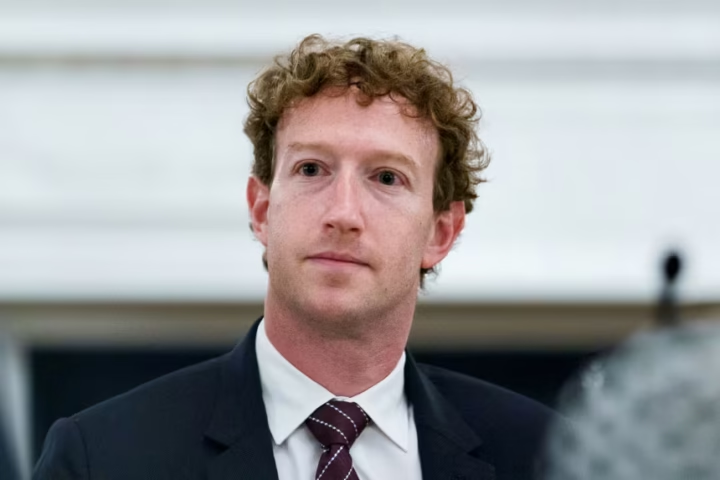

Meta Chief Executive Officer Mark Zuckerberg has cautioned the United States against banning Chinese artificial intelligence models, arguing that restrictions alone will not secure America’s leadership in one of the world’s most strategically important technologies.
In an interview with the Financial Times, Zuckerberg said that blocking access to Chinese AI models would not be “an effective solution” and urged policymakers to focus instead on strengthening the competitiveness of the U.S. technology sector.
Rather than relying on bans, Zuckerberg suggested that American companies should systematically identify the obstacles limiting innovation, improve research capabilities, and address bottlenecks that could hinder long-term progress in artificial intelligence.
His remarks come as the United States intensifies discussions over AI regulation and national security while facing rapidly advancing competition from Chinese technology companies. Artificial intelligence has become a central area of geopolitical and economic competition, with governments increasingly viewing AI leadership as critical to future economic growth, defense, and technological influence.
The debate has intensified following allegations from senior officials within the Trump administration that Chinese startup Moonshot AI may have improperly used models developed by U.S. competitors to train its latest large language model, Kimi K3. Moonshot AI has denied the allegations.
Adding to the growing scrutiny, U.S. Treasury Secretary Scott Bessent recently stated that sanctions could be considered if Chinese AI laboratories were found to have crossed legal boundaries involving intellectual property theft.
Meanwhile, the U.S. government has continued to strengthen its national security measures related to emerging technologies. On Tuesday, authorities announced a ban on new imports of foreign-manufactured humanoid and quadruped robots, citing concerns that such technologies could present unacceptable risks to national security.
Zuckerberg’s comments highlight a contrasting perspective within the broader policy debate. While some government officials advocate tighter restrictions on Chinese technology to protect national interests, the Meta CEO argues that sustained innovation, investment, and stronger domestic capabilities will ultimately prove more effective than limiting access to foreign AI models.
As artificial intelligence reshapes industries and global economies, the discussion surrounding regulation, intellectual property protection, technological competition, and international collaboration is expected to remain at the forefront of policy decisions in both Washington and Beijing.